Compact specification handoff
A continuity tester remote is an identifier that answers a host tester. LinkScope Sourcing 60 uses this brief so a buyer can mark which facts are locked and which facts are still open before a factory substitutes another remote. The desk is an independent sourcing partner. It does not pair hardware in a lab.
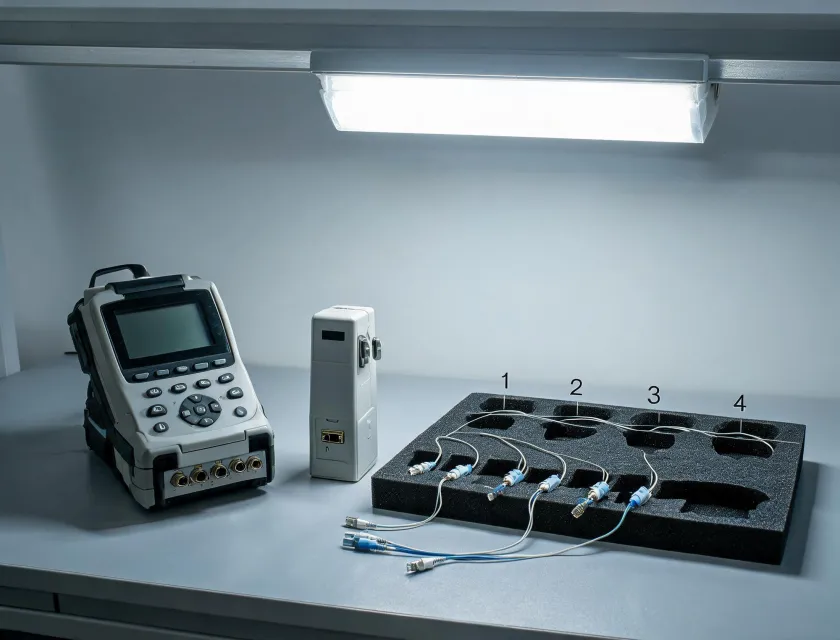
Background for a sourcing scenario: a field kit already has a fiber tester, and the buyer needs extra remotes for two crews. Process: write the host model, then ask each factory whether the remote is the maker part or a compatible part, and which ID codes it stores. Result to compare: a quote that either matches the host or lists the deviation. A matching photo of a pocket clip is not pairing evidence.
| Choice still open | Maker remote argument | Compatible remote argument | Check before acceptance |
|---|---|---|---|
| Pairing | May follow the host maker support policy and the ID list in that manual | May widen supply when the exact host is tested and the deviation is written | Both model names on one pairing note |
| Fiber wavelength | Single-mode crews may need 1310 nm or 1550 nm identification | A building crew on OM4 may need 850 nm and a different connector | Plant type stated on the brief, not inferred |
| Condition | A new remote can include a current label and a full ID set | A refurbished remote can cover a discontinued ID if condition and missing caps are listed | Serial or lot, and what is absent from the kit |
Measurement accuracy is usually a host-tester topic. If the remote itself has no numeric accuracy, say so. Do not copy the host meter accuracy onto the remote line. Insertion loss and return loss are not remote specifications unless the quote is actually for a test cord. Optical budget, receiver sensitivity, and transmit power stay with the network optic, not this identifier.
A single-mode crew can argue that a remote without a 1310 nm or 1550 nm note will be useless on an outside-plant span. A multimode crew can argue that an 850 nm remote with an LC or SC face is the part that matches a short building run. Both arguments depend on the plant already written in the brief. Shipping the other remote because it was in stock at the factory is a deviation, and the quote should label it that way.
New stock can make the ID legend readable and the battery door current. Refurbished stock can be the route when the host tester is itself out of production, if the seller states scratched housings, weak tone, and whether a function check against the named host was done. This desk does not perform that check.
Three limits belong on the handoff. A remote does not measure data rate, channel width, or MIMO. It does not carry an impedance or VSWR figure unless the part is actually an RF accessory misnamed in the email. FCC or NRTL paperwork is requested when the host is an active instrument; a passive identifier may have neither, and the supplier should say which case applies. Connector mating cycle, if the datasheet states a count, stays on the adapter line.
Related inquiry names are on the product list. The IEEE 802 overview and ITU-T fiber texts can help name the plant. They are not remote test reports.
Send the host model, the open choices above, quantity, destination, and timing. If a target budget exists, state the amount or range, the currency, and whether it is per unit or the whole order. A high-end, mid-range, budget, or undecided preference can be included as a buyer note. It is not a factory score.
Ask the factory to repeat the host model on the quote so an alternate remote cannot hide in a kit price. Then compare calibration or function-check wording line by line.
Request Factory QuotesQualified briefs can include sourcing support of up to 3%.
Eligibility applies to qualified business buyers and is confirmed after we review your product, quantity, destination, and sourcing requirements.
Prepare a Telecom RFQ