Range and accuracy
State the resistance range and the measurement accuracy the buyer will accept. If the figure is unknown, mark it unknown so factories do not invent a shared number.
Quote preparation for a handheld copper checker
LinkScope Sourcing 60 is an independent sourcing partner. This page sets the lines a factory must answer before an electric continuity tester pen is compared with another pen. It is not a safety approval and not a statement that any pen is in a warehouse.
Write the measurement function the buyer actually needs: audible continuity, a resistance range, or a voltage presence check. If the supplier quotes a 0 to 100 ohm range, ask for the accuracy note at a stated point, such as plus or minus 1 ohm, and whether that note is on the datasheet for the quoted model. A family brochure is a question source, not the quote.
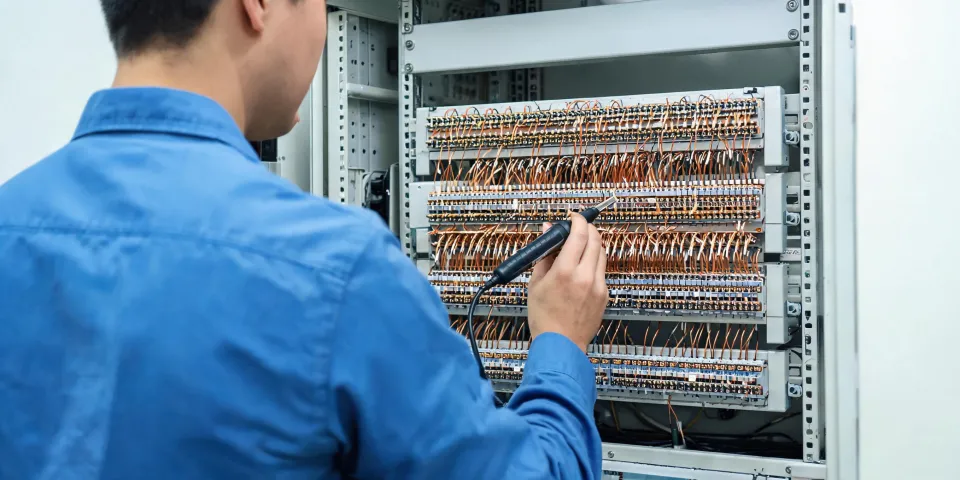
State the resistance range and the measurement accuracy the buyer will accept. If the figure is unknown, mark it unknown so factories do not invent a shared number.
Ask for the safety category printed for that model, for example CAT II or CAT III, and the voltage the pen is rated to approach. Do not copy a category from a different meter.
List leads, clips, and a pouch as included or excluded. A missing lead changes the incoming check and the price comparison.
Record battery type, operating temperature if the datasheet states one, and whether the closet or the outside plant is the use site. Power over Ethernet is out of scope for a pen.
Commercial lines stay beside the specification: quantity, US destination, requested timing, currency, and a per-unit or whole-order budget if the buyer has one. Calibration traceability, when a pen even has a certificate, must name the serial number and the date range. Many pens ship with a production test note instead. Ask which document the quote includes.
Return loss, insertion loss, optical budget, and wavelength belong on a fiber brief, not on this pen checklist. If the plant is fiber, use the fiber and remote inquiry names rather than forcing a copper pen into that comparison.
Sourcing scenario: a closet contractor is buying pens for punch-down crews. The process is to lock the resistance range, the safety category, and the lead set before price lines are opened. The result to compare is a quote that repeats those three items and says whether a 9 V battery, or another cell, is included.
| Pen attribute | Example of a complete answer | Wrong transfer |
|---|---|---|
| Range | 0 to 100 ohm, with the sheet accuracy | A 0.5 dB fiber figure |
| Measurement accuracy | Plus or minus 1 ohm at the stated point | Copied from another meter |
| Safety category | CAT II or CAT III as printed | A rack unit label |
| Runtime | Hours per battery if the sheet states them | An assumed shift |
| Ingress protection | Blank, unless an outdoor sleeve is quoted | A vault rating from a cabinet |
| Frequency range | Not a pen function | Certifier bandwidth |
| Impedance and VSWR | RF tools, not this pen | A tone beep |
A maker-supplied lead can match the contact the pen was designed around, which matters when the tip is a proprietary bayonet. A compatible lead can be sourced when the buyer checks contact size, voltage rating, and whether the maker support policy still covers the pen. Neither side is settled by the word compatible on a listing.
A new pen can show a current instruction sheet and a clear battery compartment spec. A refurbished pen can fill a discontinued tip style when the seller states cosmetic condition, replaced parts, and whether a calibration or function check is included. Price those documents, not the age label alone.
The pen does not map an Ethernet channel, does not read fiber, and does not prove a rack ground scheme. FCC equipment authorization is often irrelevant to a passive pen; if a supplier claims a radio function, ask for the exact model filing. NRTL marks, when shown, must match the model on the quote. This desk does not issue those marks.
IEEE 802 language can describe the closet the pen is used in. It does not set a continuity threshold. ITU-T fiber texts are the wrong reference for this copper form.
Include specification, quantity, destination, and timing. Add the safety category you need confirmed, the probe list, and any high-end, mid-range, budget, or undecided supplier preference. The preference is not a verified rating.
LinkScope Sourcing 60 will ask suppliers to separate compliant lines, deviations, and exclusions. Freight, duties, and spare leads stay visible before anyone treats two quotes as comparable.
Request Factory QuotesQualified briefs can include sourcing support of up to 3%.
Eligibility applies to qualified business buyers and is confirmed after we review your product, quantity, destination, and sourcing requirements.
Prepare a Telecom RFQ